
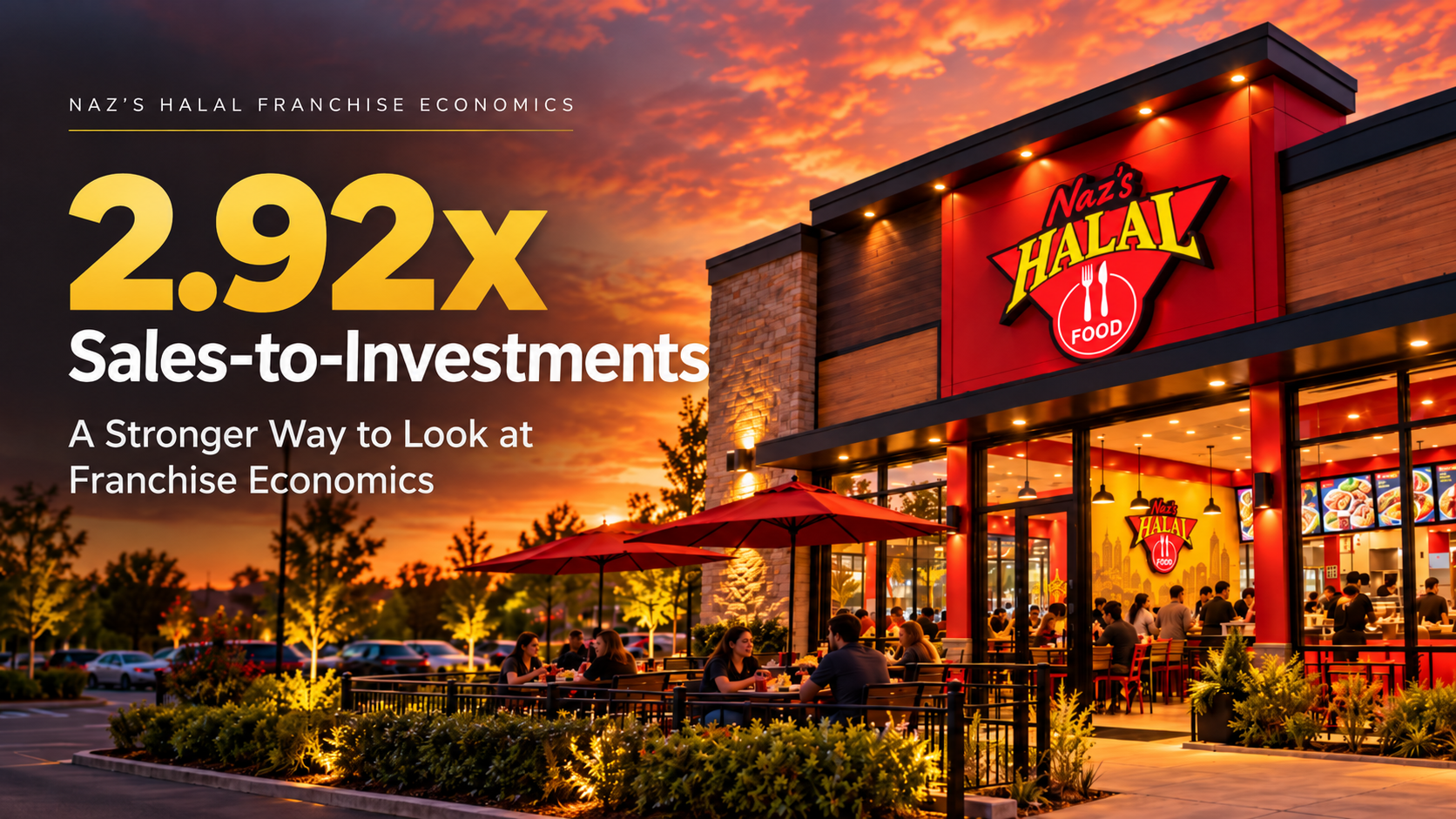
What Is a Healthy Sales-to-Investment Ratio in Restaurant Franchising?
When evaluating a restaurant franchise, candidates naturally look at the initial investment and the brand’s reported sales performance. Those numbers matter individually, but comparing them together can provide a more useful view of how efficiently a concept converts required capital into unit-level sales.
One simple comparison is the sales-to-investment ratio:
Average Unit Sales ÷ Initial Investment
This ratio is sometimes informally referred to as an investment-to-AUV or “golden ratio.” It is not an official franchise-industry financial standard, and it should not be confused with profitability, return on investment or payback period. Instead, it gives franchise candidates another way to compare the scale of a restaurant’s reported sales with the capital required to open it.
Naz’s Halal Approaches a 3:1 Sales-to-Investment Ratio
According to the current 2026 Franchise Disclosure Document, Naz’s Halal reports average 2025 Gross Sales of $1,707,956.65 for the applicable population of 43 restaurants.
The estimated initial investment to open a Naz’s Halal restaurant is $322,800 to $584,000.
To keep the comparison conservative, the ratio can be calculated using the highest end of the disclosed investment range rather than the low end or midpoint.
Maximum Estimated Initial Investment*
Average 2025 Gross Sales*
Sales-to-Investment Relationship
$1,707,956.65 ÷ $584,000 = 2.92x
In other words, average reported Gross Sales are approximately 2.9 times the maximum estimated initial investment.
Using the highest end of the investment range makes the comparison more conservative and avoids overstating the relationship by using the lowest possible startup cost.
Candidates can review the full current franchise fee, estimated investment and ongoing fees on the
Naz’s Halal Investment page.
Why the Sales-to-Investment Ratio Matters
Restaurant franchise opportunities can require dramatically different levels of capital.
One concept may generate impressive annual sales but require a very large freestanding building, extensive kitchen infrastructure or a multimillion-dollar initial investment. Another may require much less capital but also generate substantially lower sales.
The sales-to-investment ratio helps candidates consider both sides of that equation at the same time.
A stronger ratio can suggest that the capital required to establish a location is relatively efficient compared with the sales volume the concept has demonstrated.
It is important, however, to understand what the metric does not show. Gross Sales do not account for labor, food costs, rent, royalties, marketing expenses, debt service, taxes or other operating costs.
The ratio is therefore a useful screening and comparison tool, not a measure of profitability.
How Naz’s Halal Compares With Other Strong Restaurant Concepts
Several respected restaurant franchise systems also show strong relationships between reported unit sales and required investment.
The exact figures and calculation methods vary by brand, which is why comparisons should always be made carefully and with the same methodology whenever possible.
| Brand | Approx. Reported Sales | Investment Reference | Approx. Relationship |
|---|---|---|---|
| Naz’s Halal | $1.708M average Gross Sales | $584K maximum estimated investment | 2.92x |
| Jersey Mike’s | Approximately $1.4M | Approximately $515K average investment | Approximately 2.6x |
| Wingstop | Approximately $2.0M | Investment varies by location and buildout | Can approach 3x using midpoint comparisons |
| Pokeworks | Approximately $1.08M | Investment varies by format | Approximately mid-2x range using midpoint comparisons |
These examples help illustrate why strong restaurant franchise systems are often evaluated not only by total sales, but by how much capital is required to produce those sales.
Real Estate Footprint Plays a Supporting Role
Real estate should not lead the story, but it is an important part of the economics.
Naz’s Halal restaurants are generally designed for approximately 1,800 to 2,400 square feet.
That size can provide access to traditional retail centers, inline spaces and end-cap opportunities without requiring the much larger footprint associated with some restaurant concepts.
For a franchisee, a manageable footprint can matter because a restaurant concept is only scalable if operators can repeatedly find appropriate sites in their target markets.
The stronger story is not simply “smaller real estate.” It is the combination of strong sales, manageable investment and a repeatable restaurant footprint.
Why the Economics Matter Even More for Multi-Unit Candidates
The economics of a single restaurant matter. For a multi-unit operator, however, the model also has to be repeatable.
Naz’s Halal offers area development opportunities generally structured around commitments for three to five restaurants, giving qualified franchisees a path toward developing multiple locations within a market.
Approximately 75% of Naz’s Halal franchise owners operate multiple locations, which provides another indication that many existing operators have chosen to expand beyond one restaurant.
Learn more about the brand’s
multi-unit franchise opportunity.
For a multi-unit candidate, several questions naturally become connected:
- How much capital does each restaurant require?
- How much sales volume has the system demonstrated?
- How difficult is it to find suitable real estate?
- Can the operating model be replicated across multiple locations?
The sales-to-investment relationship helps put the first two questions into context, while footprint and operating structure help frame the scalability discussion.
Why AUV Alone Can Be Misleading
AUV is an important metric, but it should never be viewed in isolation.
Imagine two restaurant concepts.
One generates $2.5 million in annual sales but requires $1.8 million to open. Another generates $1.7 million in annual sales but can be developed for less than $600,000.
Looking only at sales, the first concept appears larger. Looking at the relationship between sales and required capital tells a much different story.
That is why serious franchise candidates should evaluate several factors together:
- Initial investment
- Average unit sales
- Restaurant footprint
- Ongoing fees
- Operating model
- Multi-unit development requirements
No single metric determines whether a franchise is a good investment. The objective is to understand how the pieces work together.
Naz’s Halal: Approximately $2.92 in Average Gross Sales for Every $1 of Maximum Initial Investment
Viewed through this lens, Naz’s Halal presents a compelling financial profile.
Maximum Estimated Initial Investment
Average 2025 Gross Sales
Average Gross Sales ÷ Maximum Investment
That is approximately $2.92 in reported average annual Gross Sales for every $1 represented by the highest end of the estimated initial investment range.
Again, this is a sales comparison. It is not a representation of profit, earnings, return on investment or expected payback period.
But for candidates comparing restaurant franchise opportunities, it provides another useful way to understand the Naz’s Halal model.
Explore the economics behind the Naz’s Halal franchise opportunity and learn how the model can support multi-unit development.
*Average 2025 Gross Sales of $1,707,956.65 reflects the applicable population of 43 restaurants reported in Item 19 of the 2026 Naz’s Halal Franchise Disclosure Document. Estimated initial investment is $322,800–$584,000. Gross Sales are not the same as profit or earnings. Prospective franchisees should review the current FDD and conduct their own financial and legal analysis before making an investment decision.
